
Part 1. Watching Closely: Learning From Children at Play
A 3-part series observational in nature and research-informed. Written by Lainie Holmes, founder and creator of LYKKE Kids in Toronto, Ontario
As we enter the world of weapon play and “bad guys / good guys,” it feels inevitable that we talk about sticks.
Yes, sticks.
Because if you take a kiddo to a park or outside for a walk, they will inevitably find “a good stick.” One they can poke with, whack with, or one that looks like a gun…
And because sticks can be seen or used as weapons, we’re here to talk about how kids use them in their play.
How Do Kids Use Sticks in Play?
This first part of the 3-part series will share first hand observations I made one day (as an educator) while at the park with 5 year old boys currently in our our recreational kindergarten program.
I had been thinking a lot about weapon play at that time, especially after seeing the kids create cardboard knives in the construction room and asking for help as they made cardboard swords. It made me feel a bit uneasy.
Should I let them? I’m not sure how their families feel about this type of play. I’m not sure how much I know about this type of play. It is okay?
And so my professional reading began. I started to read research from reputable sources about weapon play in children. Why do they do it? What does it mean? And on this particular fall day, I decided that I wanted to see for myself firsthand.
What are they actually doing with the sticks and the weapons when they play?
Collecting Data
I decided I would record my observations on my phone. I wrote down everything that I heard the kids say - writing down their exact words as quotes. I wrote down a list of everything I saw them use a stick for - writing down fact, not inferences. I remembered the Ladder of Inference; we had learned about it during a professional learning session at work one time. Harvard facilitators came in to host a session for our consultant team (part of the curriculum department for a school board).
We learned that when we see something, we can quickly jump up the rungs of the ladder and make assumptions or conclusions (our brains love simplicity and will take short cuts to be efficient). But by sticking to facts and slowly moving up the rungs, we have a framework that helps us reduce bias, encourages objective evidence-based data and promotes reflection.
(More about the Ladder of Inference here if interested in learning more about the ladder - in the context of an educational setting)
Anyways, I tried to be as neutral as possible keeping this framework in mind. My goal was to simply collect data and try to stay as factual as possible. I would be a play researcher at the park - taking notes about how the kids were using sticks in their play.
And I didn’t expect what I observed…
Out loud, the kids called sticks:
“a laser”
”a ship blocker”
”a wand”
”a door”
”keys of iron to free me from the ship”
I haven’t omitted anything from this list. This is everything I heard on that day. Notice in this list that there is no reference to a stick as: a knife, a sword, or a gun on this day of observation.
What did they do with their sticks?
They poked leaves
”To create lightning” as they rubbed and hit two sticks together
Tapped sticks against metal surfaces
Tapped sticks against a metal steering wheel which then made a ringing noise that echoed
Tapped metal with sticks to make a sound “that would make the sea monster fall asleep” and “then another sound to wake it up”
Squeezed sticks through metal slats
Launched sticks off play equipment
Used sticks to flip over leaves
To hit the ground (“Look what happens when the stick pounds the ground!”)
Pushed “a button” (invisible of course)
Isn’t this so neat?!
What do you notice in this list? Take a moment to re-read it before moving on. Really, I’m curious to see what you take from it. What do you notice?
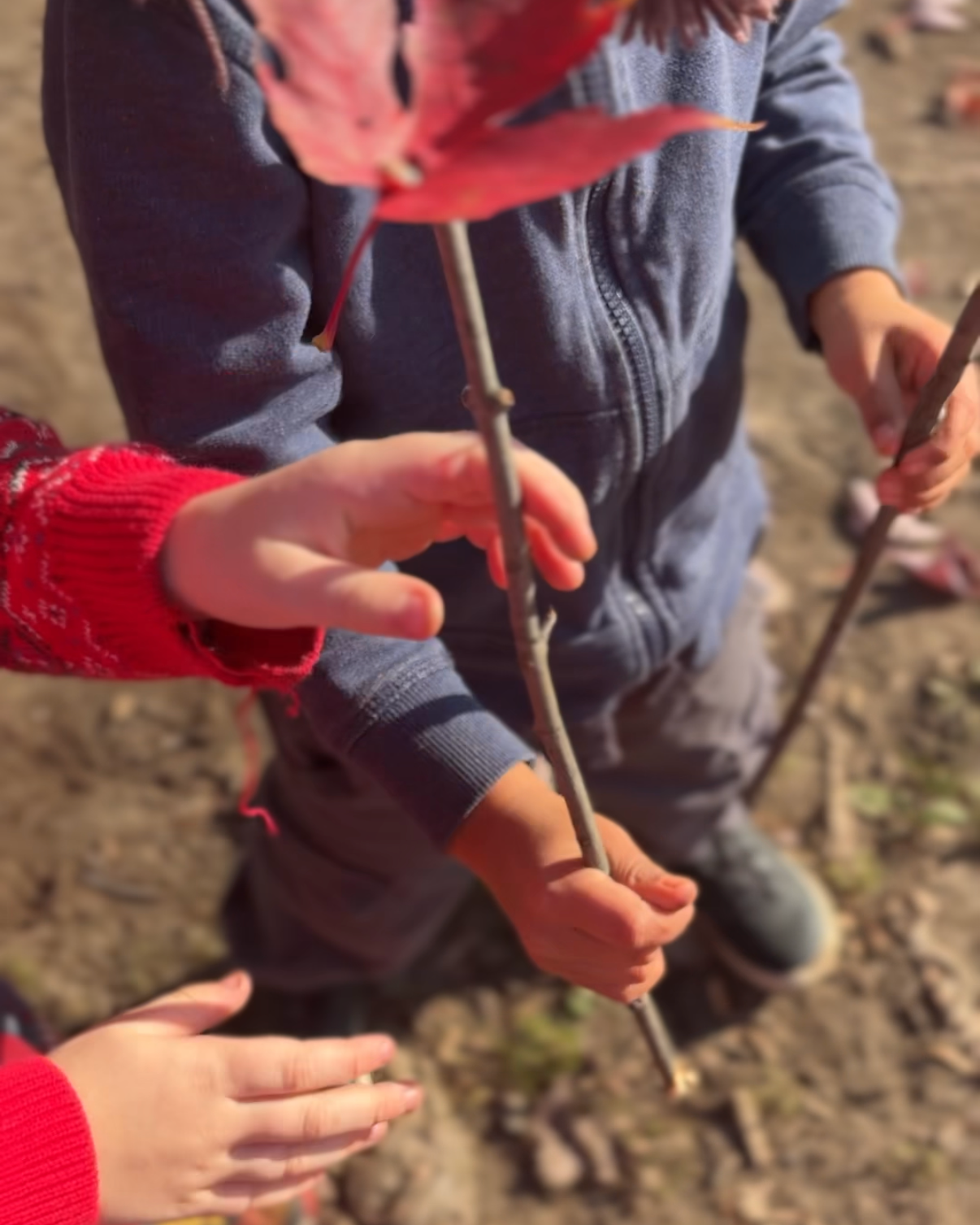
What Was Noticed
For me, I noticed how much their play with sticks seemed tied to movement.
When re-reading the list, I noticed the verbs: tapped, squeezed, launched, hit, pushed, poked. If I were to move more to assumptions, conclusions or beliefs, it was like they were using the sticks as an extension of their own hands or that they wanted to see what the sticks would do (when being launched, when tapping a metal surface…)
I noticed cause-and-effect in their play. If I tap this stick on a metal surface, it makes this sound… If I launch this stick off the playground equipment… If I hit the stick on the ground…
And last, the sticks were also used to represent different objects.
Sticks as a Tool for Symbolic Play
The stick began as a laser. It then became a ship blocker - to “keys of iron to free me from the ship!” It was fascinating to hear how the sticks seemed to evolve into the next object the boys needed, as their story and play unfolded.
Symbolic play, also known as pretend play, is when kids use an object to represent something else. And because sticks are open-ended items, they allow kids to use their imagination and creativity in an ever-evolving way. It doesn’t stay as just a stick, silly! It can be anything. It just wasn’t what I expected...
What Wasn’t Seen
I did not observe the boys hitting each other or anyone else with the sticks.
No one was hurt. No one was threatened with a stick. The sticks were used solely for imaginative play.
Now if it were another day, maybe that wouldn’t be the case. Maybe the energy would be different and the play would go in a different direction. But on this day, it didn’t. And like any adult, if I was concerned about safety, we would pause and have a conversation.
Grown-up Worries
As grown-ups, we can be quick to imagine what can go wrong once that stick is in a hand (myself included). Please don’t poke someone in the eye... and rightfully so, it’s our role as grown-ups to help take care of kids.
I just wonder what might happen if we pause first, even for a little bit, to watch what they are doing before we shut it down. If we tried to understand from their point of view… Are they curious to see how things move? Do they like the sound it makes? Because if we take away that stick, we might be taking away the only piece that can defeat the evil sea monster that hasn’t arrived yet…
Further Reading on the Topic:
Loose Parts Play (Flannigan, 2017), Journal of Childhood Studies
an interesting read that makes the connections between loose parts (like sticks), risky play, and how they support a child’s sense of agency in play.
Kids’ Thoughts on the Topic:
I asked our 11 year old son, “Is it okay for kids to play with sticks?”
His response: “It depends on the situation. If they are playing pirates and they are pretending it's a sword or knife, that's okay. But if they want to use it to hurt someone, that's not."
- 11 years old
Just joining us in the series?
Great to have you here! This was the Intro: Good Guys, Bad Guys, and the Language of Play
and Coming Next Week: Testing Boundaries with Sword Play