
Why Mixed Aged Groupings are Important
Kids spend a lot of time in environments where kids are the same age as them.
It begins as early as when they’re infants - postnatal groups organized in a way that babies are born within weeks of one another, Mommy groups organized by the number of months old their child is, baby classes, play groups… and it continues into the early years with daycare settings and preschool programs.
It continues on into the school-aged years with their classrooms organized by peers the same age, extra-curriculars, sports, and clubs… play dates often organized or coordinated with same aged peers. Unless you have a younger cousin or sibling, it’s possible that you may not spend any time with someone younger than you.
And I get why it happens. It’s nice to talk to someone who is at the same stage as you, sleep deprived like you are, trying to figure out life with a baby. It’s nice to be with people who truly get it and are right there with you. That classes or extra-curriculars would be organized by age so developmentally they would be around the same skill level (which helps with planning). It makes things easier. There is value in grouping by age.
There is also great value in mixing up ages and that’s not something we see a lot of. And we’re missing something because of it...
“My Sister”
This summer, our kids got to spend time with their two cousins. Cousins they see once a year, as we are spread out by provinces. Their cousins are 3 years old and 11.
Something I often hear from families is that their older kids are “too big for that now.” Too big to be into painting. Too big to be into creating or imaginative play. Too big for a sandbox. Too big to play on the floor.
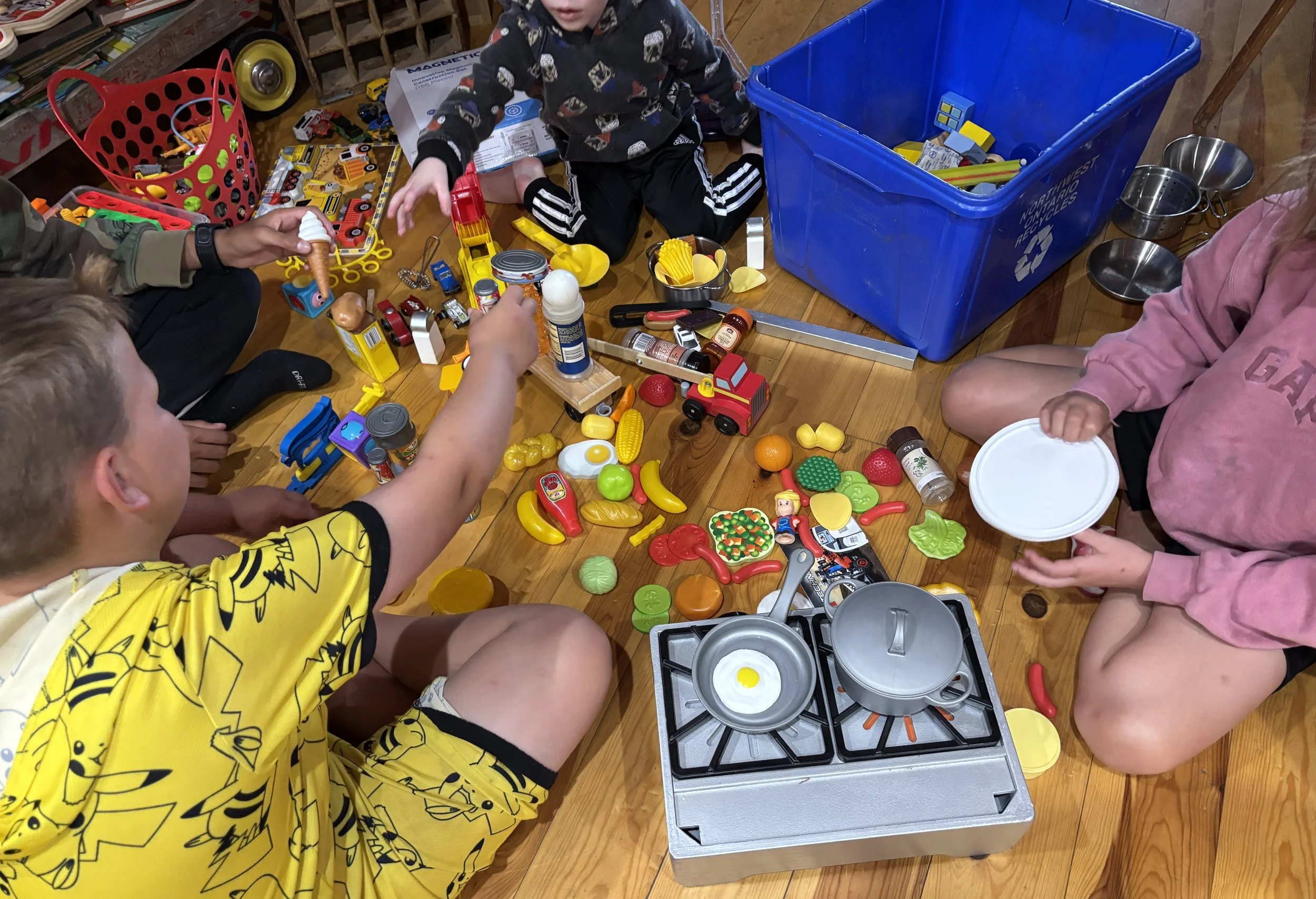
Below is a picture I took this summer. I’m sharing it because I was genuinely surprised to see it happen myself.
In this picture, you’ll see three big kids (ages 8, 9, and 11 - not pictured is the 10 year old just out of the frame) sitting on the floor, in a circle, with a little 3 year old.
A bin of toys has been emptied. There is a little kitchen set with a frying pan (with an egg inside) sitting on top of a stove. A pot is on the stove next to it. A collection of food is spread out on the floor in the middle of them. A wooden truck has empty spice bottles set on it’s trailer, some stacked. The kids are placing bottles and items on the trailer.
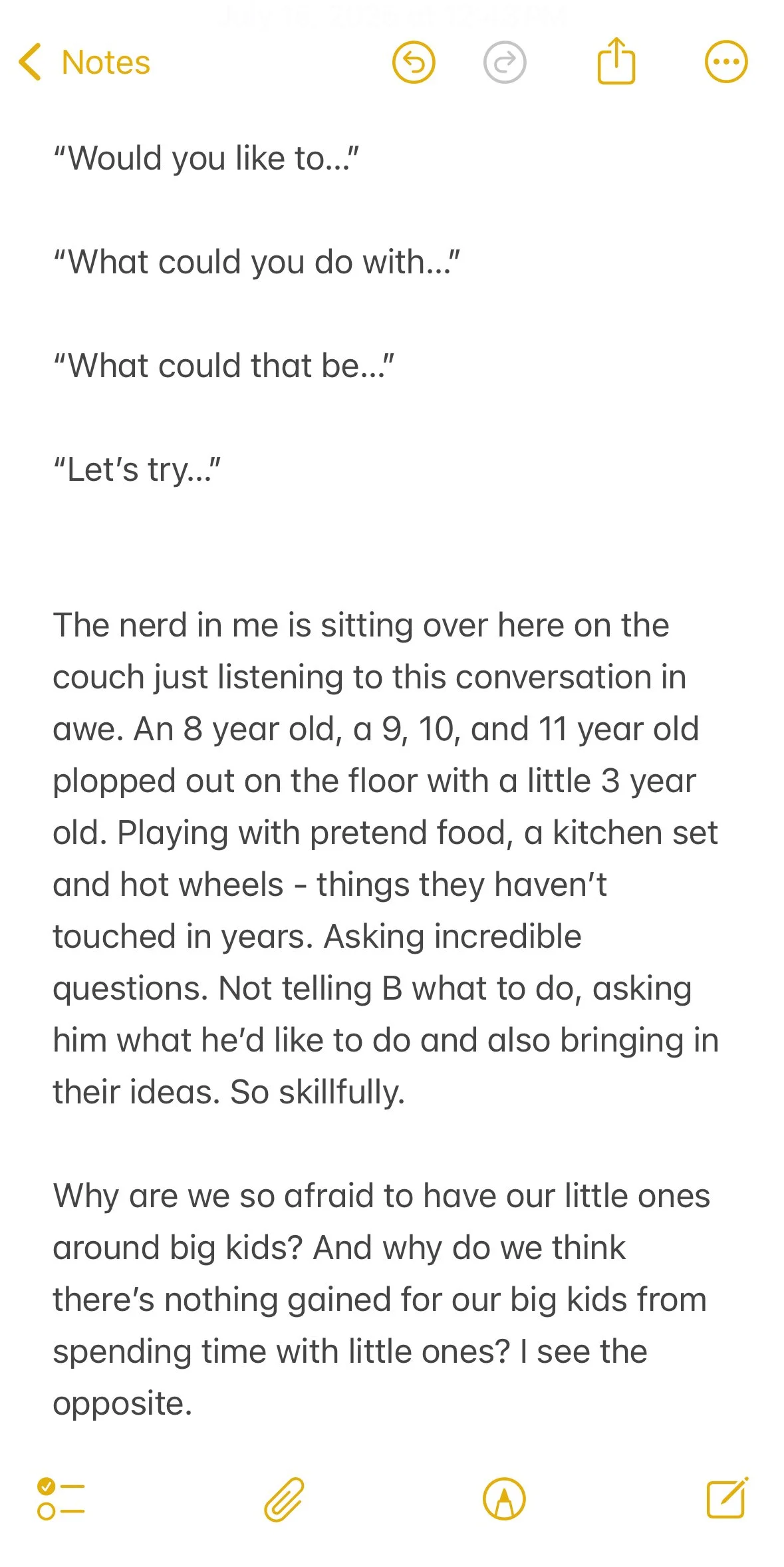
Notes I took on my phone as I sat and watched these big kids play.
Our nephew enjoyed spending time with the big kids, so much that he began to lovingly call our daughter, “my sister.” Connections happen between big kids and little ones, and it benefits them both.
Roots of Empathy
You might be familiar with the program called, Roots of Empathy.
It’s an international, evidence and empathy-based classroom program designed for children ages 5 to 13. The program where they bring a small infant into a classroom for repeated facilitated visits (with a trained Roots of Empathy Instructor) over a period of time so that kids can observe the baby grow and change - developing their own empathy in the process.
In Roots of Empathy, emotional literacy develops as children begin to identify and label the baby’s feelings, reflect on and understand their own feelings, then bridge to understand the feelings of others (excerpt from the Roots of Empathy website).
Since 2000, the Roots of Empathy program has been evaluated by independent researchers through comparative and randomized controlled studies designed to measure the impact of the program on children’s behaviour and social well-being. This research has been conducted in numerous countries across three continents.
Independent research has found that children in the Roots of Empathy program experience:
An increase in prosocial behaviours (E.g., sharing, helping, and including)
An increase in empathy
And a decrease in aggressive behaviours, including bullying
And a randomized, accelerated, longitudinal study conducted in Manitoba, Canada showed a decrease in physical and indirect aggression in children, both immediately and three-years after program completion (Santos et al, 2011). The study also found an increase in prosocial behaviours (sharing, helping, including) in children immediately following the program.
So why share this? Where am I going with this?
I think it’s neat to see what happens when kids spend time around little ones. And it’s not just something that is nice to do, there are actual studies that have been done to measure the impact and the effect it has our
children and their well-being. That is fascinating and something for us to pay attention to.
Because big kids have SO much to gain from spending time with and around little ones.
Time and time again, I have watched in the space (at LYKKE Kids) as big kids have softened as soon as they are around little ones. Big kids who act so grown-up, kids who don’t want to go into a “baby place,” who are then speaking sweetly with little ones, joining in the play, and having fun together.
I have watched as a 9 year old girl ooohed and aaahed over a little one year old boy, who she had never met before. Getting down on the floor with him and handing him toys. I’ve watched as a 3 year old boy was fascinated by a baby with another family. Watching the baby closely, going off to play but coming back to check in on her as she slept in her bassinet. He had met someone smaller than him.
Or the conversations that happen between kids of different ages. Like the day two kids met for the first time in the construction room and somehow got to talking about what grade they were in. One shared that she would soon be starting grade 1 and was feeling nervous about it. The older boy reassured her, “oh, grade 1? It was fantastic!” Relief. It just lands differently when it comes from a fellow kid.
Creative, Curious + Kind!
So when it came time to envision a program for kids that would happen after school, I didn’t hesitate for it to be mixed ages; it’s exactly what I wanted to offer. Absolutely, let’s do something for kids ages 6 - 12. Some may look at it and find it strange that a six year old would be in a program with a 10 or 12 year old. I don’t find it strange at all. I see it as full of possibility...
I picture a group of kids, a mix of ages, like a group of cousins, who are happy to be together and making their own fun. Each person playing an important role. Finding ways to include each other. Taking turns leading. Each contributing in their own ways.
Because each age contributes to the growth and learning of the other…
Abstract from Peter Gray’s article, The Special Value of Age-Mixed Play (2007)
From an evolutionary perspective, the normal social play of children involves kids of various ages. Our human and great-ape ancestors most likely lived in small groups with low birth rates, which made play with others of nearly the same age rare. Consequently, the evolutionary functions of children's social play are best understood by examining play in groups that include children of different ages. The author calls this kind of play "age mixed." He reviews the research on such play, including his own research conducted at the Sudbury Valley School in Massachusetts where students from ages four to about eighteen mix freely. He concludes that age-mixed play offers opportunities for learning and development not present in play among those close in age, permitting younger children to learn more from older playmates than they could from playing with only their peers. In age-mixed play, the more sophisticated behavior of older children offers role models for younger children, who also typically receive more emotional support from older kids than from those near their own age. Age-mixed play also permits older children to learn by teaching and to practice nurturance and leadership; and they are often inspired by the imagination and creativity of their younger playmates. The picture of a group of children all nearly the same age playing in a school yard may seem familiar to modern eyes, but it is an odd image from the long perspective of human cultural and evolutionary history. As anthropologist Melvin Konner pointed out more than thirty-five years ago, play among children close in age (same-age play) is largely an artifact of modern times. Same-age play became common only with the rise of age-graded schooling and, still more recently, with the proliferation of age-graded, adult-organized activities for children outside schools. Over the history of our species, as natural selection shaped the brain mechanisms of play, children's social play usually occurred among individuals of different ages, often widely different ages. Therefore, if we want to understand the evolutionary value of children's social play—the adaptive functions that led natural selection to shape social play into its human forms—we should observe such play among children in age-mixed groups.
“...age-mixed play offers opportunities for learning and development not present in play among those close in age, permitting younger children to learn more from older playmates than they could from playing with only their peers. ”
“In age-mixed play, the more sophisticated behaviour of older children offers role models for younger children, who also typically receive more emotional support from older kids than from those near their own age.”
“Age-mixed play also permits older children to learn by teaching and to practice nurturance and leadership; and they are often inspired by the imagination and creativity of their younger playmates.”
His article reminds us that kids need to spend time around other kids, and kids of all ages.
I feel very thankful to spend time in a space filled with newborns, toddlers, preschoolers, school-aged kids, new parents, parents with multiple children, aunts, uncles, nannies and caregivers, friends and grandparents. It’s like seeing the full spectrum of being a human being - through every stage of life. And the piece that we end up missing, when we’re only spending time with same aged peers, is that time passes.
When we’re in the depths of diapers and naps, we think it will always be this way, and it won’t. When we see a grandparent getting down on the floor with their grand kids, it reminds us to take care of our bodies now so we’ll be able to do the same. We each teach other things, at all ages. It’s why we need to be together. So let’s mix things up.